Can AI actually read your practice website? Check in 40 seconds
A free scan shows exactly what ChatGPT and Google can read about your practice
A Free 40 Second Scan Shows What AI Can Read About Your Practice
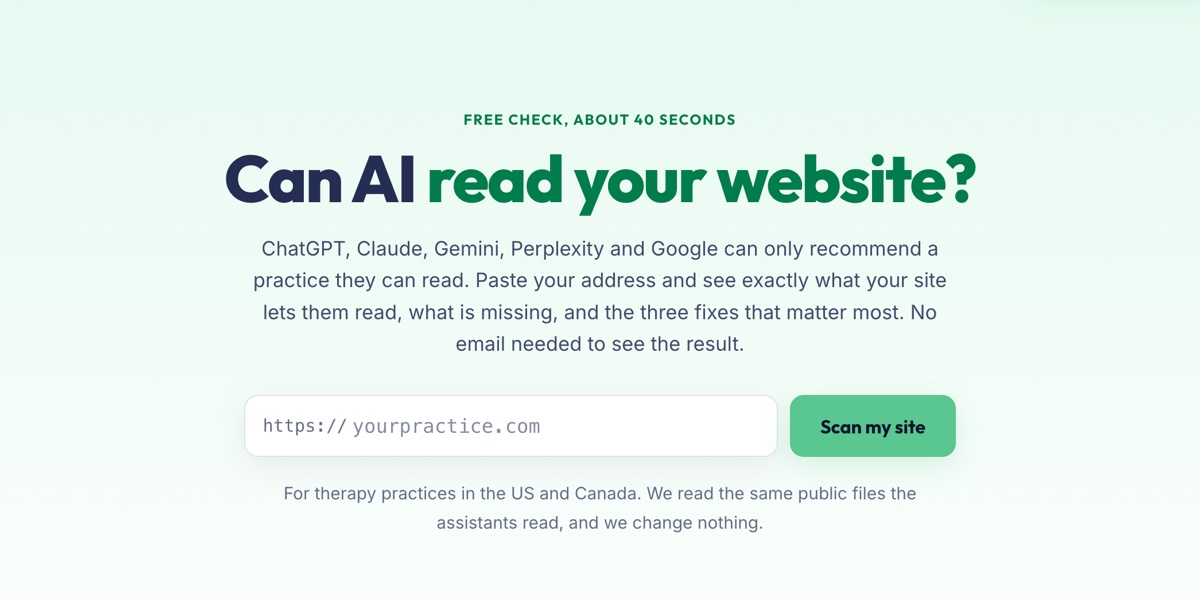
Moonraker launched a free scan on September 5 at moonraker.ai/scan. Paste in your website address and within about 40 seconds it tells you whether ChatGPT, Claude, Gemini, Perplexity and Google can actually read your practice as facts. It checks structured data, llms.txt, AI crawler rules, up to twelve pages from your sitemap for the SEO basics, whether your Google Business Profile links back to your site, and Google's mobile speed score.
No email required to see the result, and every result comes with a shareable link. This measures readiness, whether AI can read you at all. Being named in an AI answer is a separate, harder question, and the free visibility audit still covers that.
Do this now:
- Run your website through the free scan at moonraker.ai/scan and read the three fixes it lists first.
- Send the result link to whoever maintains your website, with the fixes in order.
- Re-run the scan ten minutes after each fix to confirm it landed.
Google Now Opens AI Mode Automatically for Some Searches

Starting August 27, Google began expanding some AI Overviews into full AI Mode responses automatically, without the user clicking Show more. The complete AI answer appears with the Ask anything box already open, pushing traditional search results further down the page. A Google spokesperson said this happens for topics where the system determines it's most useful, but Google has not said which topics qualify.
For a practice, a search like anxiety therapist in Burlington can now resolve into a full conversation before anyone sees a single link. Only pages with clear, readable facts get cited inside that conversation, the same facts a readiness scan checks for.
Do this now:
- Search your own practice name and specialty to see if AI Mode opens automatically.
- Check whether your site is cited in any AI answer you find.
- Make sure your homepage clearly states location, specialties and credentials in plain text.
Google Tests a Photo of Your Signage to Verify Your Business Profile

On September 4, Google began testing a fifth verification option for Google Business Profile: submitting a photo of your business. The photo must show your business name on a permanent fixture, such as a signboard, with the whole storefront visible in one frame. It joins phone, text, email, live video and postcard verification. Google has not updated its help documentation yet, so this appears to be a test, not a full rollout.
If you work from a home office or run an online-only practice, this option will not apply to you. The correct setup remains a service area profile with your address hidden, never a photo of your front door or home.
Do this now:
- Check your Google Business Profile dashboard for a new photo verification option.
- If you work from home, confirm your profile is set to service area with the address hidden.
- Skip signage photo verification entirely if you have no public storefront.
llms.txt Is a Five Minute Job, Not a Strategy

A monthly count of the top domains online, published August 23, found llms.txt files on 8.7 percent of the top 1,000 sites and 5.6 percent of the top 10,000 as of June 2026, up from just 0.3 percent of the top 1,000 a year earlier. Google's own documentation, last updated December 10, 2025, states plainly that no new machine readable files or markup are required to appear in AI Overviews or AI Mode.
The file is worth creating, it takes five minutes and forces you to write one clear paragraph about your practice. But it is worthless as a plan on its own. The real work is still readable pages, structured data and clear writing.
Do this now:
- Write a one paragraph summary of your practice in plain language today.
- Add that paragraph as an llms.txt file at your site's root, if you have someone who can.
- Spend the real effort on your pages, where that paragraph does the work.
OpenAI Announced GPT-6 This Week. Your Pages Are Still the Source.

OpenAI announced GPT-6, which it calls Astra, on September 3, describing it as its most intelligent and aligned model yet. It reaches the general public in the coming days, following a limited release to select organizations first. This is the model behind the most widely used AI assistant, and it is about to change for everyone.
What did not change is how it decides which practices to mention. A smarter model still can only recommend what it can actually read. If your website lacks clear facts about your services, location and credentials, a better model will not help you get found. The upgrade changes the writing, not the sourcing.
Do this now:
- Ask ChatGPT, in a private window, for a therapist with your specialty in your town and note whether you appear and what it cites.
- Compare what it says about your practice by name with what your homepage actually states.
- Fix the gaps on the page first; the assistant reads the page, not your intentions.
Quick wins for the week
- Add your specialties and location in plain text on your homepage this week.
- Check whether your Google Business Profile links back to your website.
- Check your mobile speed score in the free scan; speed is part of how Google ranks pages on phones.
- Search your own practice name to see how AI Overviews describe you, if at all.
Final thoughts
Every story this week points to the same shift. AI systems are not just indexing the web anymore, they are answering questions directly, deciding what to summarize and who to name before a person ever clicks a link. Google's automatic AI Mode expansion, the new verification tests, and a smarter model from OpenAI all raise the stakes on the same basic requirement: your practice has to be readable as clear, structured fact. Files help a little. Clear writing on real pages still does the heavy lifting.
None of this requires you to become a technologist. It requires steady attention, the kind that is hard to give when you are already running a full caseload. While you're providing therapy, we're monitoring policy changes, protecting your Google presence, and optimizing for AI search. You shouldn't need to become an SEO expert, compliance specialist, and tech strategist on top of being a therapist.
Put this into practice
Use these guides to turn the story into a useful next step for your practice.
Get the next edition in your inbox
One email a week on Google, AI search, and running a visible therapy practice. No fluff, unsubscribe anytime.