Can Google and AI Understand Your Therapy Practice?
What to fix before writing more content: accurate practice details, useful service pages, schema and a booking route that works.

Before you publish another blog post, open your practice website and try to answer five questions.
Who provides the care? What do they help with? Where can someone see them? What should a prospective client expect? How do they take the next step?
Those questions sound simple. But the answers can become surprisingly hard to find once a practice has several clinicians, a few directory profiles, an old address and years of website updates.
Over the past three months, our work at Moonraker and the stories in our weekly newsletter have kept bringing me back to this: useful content needs an accurate foundation.
That foundation matters to the person looking for a therapist. It also gives search systems clearer information to work with. Before we ask whether a practice needs more content for Google or AI search, we should check whether the information already online describes the practice properly.
Your practice information needs to agree
Imagine a practice that has moved offices. Its contact page shows the new address, a therapist directory still lists the old one, and the homepage says very little about where appointments happen.
Each page might look reasonable on its own. Together, they leave someone trying to work out which information is current.
The same problem appears with services. A homepage might mention trauma therapy, while clinician profiles never explain who provides it, what their relevant training is or whether they are accepting enquiries.
More blog posts do not resolve those gaps. They add pages around information that still needs attention.
Consistency does not mean copying the same paragraph everywhere. A clinician biography and a Google Business Profile serve different purposes. The facts that overlap should agree: names, locations, contact details, services and the relationship between the clinician and the practice.
This is part of the wider question we explored in how clients find a therapist. Whatever route brings someone to your website, they still need enough clear information to decide whether to contact you.
What we changed on Moonraker’s website
We have been applying that principle to our own website.
Moonraker’s recent structured data updates connect the company, its team, its services and its tools more explicitly. Structured data, often called schema, is information in a website’s code that labels what things are and how they relate.
For example, our AI Readiness Scan and Page Clarity are described as web applications, with a connection to Moonraker as their provider. Team members are represented separately from the organisation. Services are connected to the organisation that provides them.
That is a more precise description than leaving those relationships scattered across several pages.
A therapy practice has different information to describe, but the same need for clarity:
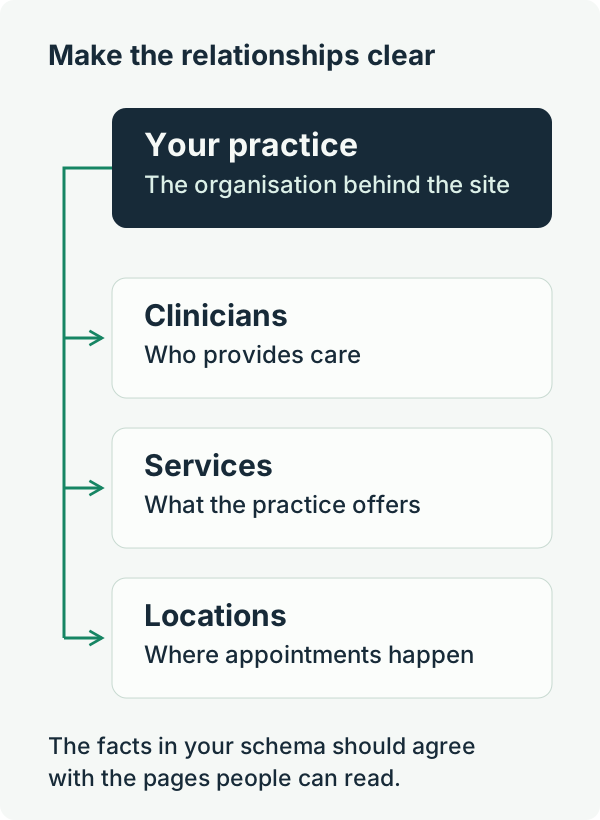
| Information | What it should make clear |
|---|---|
| Practice | The organisation behind the website |
| Clinician | Who provides care and their relationship to the practice |
| Service | What is offered and who provides it |
| Location | Where appointments are available |
| Article | Who wrote it and, where applicable, who reviewed it |
Your website provider can choose appropriate markup for those facts. You do not need to learn the code to ask a useful question: does the website describe the practice as it actually operates?
Our schema update is a technical improvement we can inspect. It does not, by itself, establish that Moonraker ranks higher or appears more often in AI answers. Those outcomes need separate evidence.
What schema can establish
Schema can make a website’s description more explicit. It cannot independently verify a clinician’s qualifications, turn a vague service page into a useful one or guarantee a recommendation.
The visible page still needs to do the work.
If a page says a service is available in person, the location should be clear. If someone provides telehealth, the page should explain where they can offer it. If markup identifies an author, that should agree with the byline a reader sees.
Google’s guidance for its AI search features says structured data should match the visible text. It also says there is no special schema or new AI text file required to appear in those features. Its existing search fundamentals still apply.
That guidance concerns Google’s systems. Other AI services have their own ways of finding and using information, so we should be careful about promises that one change will fix visibility everywhere.
A valid schema test tells you something about the markup. A website scan tells you something about the pages it examined. Neither result alone tells you whether an AI assistant will recommend your practice.
Google does not punish content simply because AI helped write it
This point deserves a clear answer: Google does not penalise content simply because it was created with AI.
Google’s guidance on AI generated content focuses on content quality and purpose, rather than treating AI use itself as a violation. Its current generative AI guidance warns that producing many pages without adding value can breach its scaled content abuse policy.
AI can help organise a draft or make an explanation clearer. The problem is publishing material that is inaccurate, repetitive or offers little help to the reader. That problem exists with human writing too.
For a therapy practice, review needs to be especially careful. Someone qualified to assess the clinical information should check claims about treatment, relevant qualifications, suitability and likely outcomes. A marketing draft should never invent expertise or promise results a clinician would not promise.
The same care applies to page titles, descriptions and schema. Incorrect information does not become acceptable because it is tucked into the code.
The useful question is whether the finished page helps someone understand the service and make an informed next step.
Five checks for your practice website
You can start with one important service page and work through these checks.
Make the important information accessible
Put the service, provider, location and next step in readable page text. A beautiful image containing essential information may be difficult to use. Ask your website provider to check that search engines can access and index the page, including any content that needs to load before it appears.
Compare the facts across your profiles
Check the website against your Google Business Profile and the directories you actively use. Correct outdated addresses, phone numbers, website links and service details. Where clinicians have separate profiles, make their connection to the practice clear.
Explain the actual service
A page headed “Anxiety Therapy” needs more than a general definition of anxiety. Explain who the service is for, who provides it, relevant training or professional registration, where sessions happen and how to enquire. Have the clinician review the clinical wording.
Check what the markup says
Ask whether the schema reflects the current page and connects the right practice, people, services and locations. Validate it after changes. Keep the scope of that check clear: correct markup is useful, but it is not proof of search performance.
Follow the booking route on your phone
Tap the contact button, try the form and follow any external booking link. Check where it takes someone, whether the right practitioner or practice appears, and whether the next step is obvious.
Our newsletter edition 49 covered Headway’s marketplace fee changes. That story is a reminder to understand the booking routes you share, including any platform terms or charges that may apply to someone using them.
Being found is only one part of the process. Someone still has to reach the right place to enquire.
Start with one service page
You do not need to rewrite the whole website this week.
Choose a service you want more suitable enquiries for. Check its facts against the clinician’s profile, the relevant location page and your active listings. Make the page useful to someone considering an appointment. Then check the markup and test the contact route.
That gives your next blog post a better destination to link to. It also gives prospective clients a clearer picture of the care available.
If you want an initial technical check, try Moonraker’s free AI Readiness Scan. It checks aspects of website access and readiness; it does not measure whether an AI assistant recommends your practice.
If you need help deciding what to fix first, Moonraker can review the practice website and help turn the findings into a practical plan. The starting point is the same: make the information accurate, make it useful and make the next step easy to find.
Put this into practice
Use these guides to turn the story into a useful next step for your practice.
One email a week on Google, Maps and AI search for therapy practices
What changed, what it means for your practice, and the one thing to do about it. Unsubscribe any time.