Your Google listing might be lying to AI right now
Plus what to tell clients about the AI risk debate everyone is talking about.
Our new free tool finds where your practice listings disagree online
On September 9 we released a free listing check. Enter your practice name, town and website, and it searches your Google Business Profile, 25 directories, the NPI registry, and the wider web for listings nobody set up on purpose. The emailed report shows exactly where your name, address and phone number disagree, and what to fix first.
In its first week, the tool found clinicians listed under their own name on Yelp and Facebook, NPI records still showing an old office address, and a Google profile with a phone number nothing else agreed with. Every one of these was fixable in an afternoon, but none of them were visible from inside the practice. It works alongside our AI readiness scan from September 5.
Do this now:
- Run your practice through the free listing check at moonraker.ai/nap-check.
- Compare the report against your Google Business Profile and note every mismatch.
- Fix the two or three highest-impact directories first, starting with Yelp and the NPI registry.
iOS 27 is out with a Siri built on Gemini. Why AI is still the play for your practice
Apple released iOS 27 on September 14 as a free update. Its centerpiece is a rebuilt Siri developed with Google's Gemini models, part of the partnership announced January 12. That puts a conversational AI assistant on every supported iPhone, alongside ChatGPT, which fields 300 million health questions a week, and Gemini, which already sits on top of Google Maps.
An APA survey of 1,242 psychologists, published June 16, found 77 percent had clients who mention using AI. A Rock Health survey of 8,000 adults found the share using a chatbot for health information doubled to 32 percent in a year. Whatever you think about the long-term risks, these assistants are where prospective clients start looking today, and one more just shipped on every iPhone.
Do this now:
- Check today whether Siri, ChatGPT or Gemini can correctly describe your practice and clinicians.
- Make sure every clinician page and listing agrees on name, credentials and location.
- Use AI tools only for drafting and admin work, never for client data, unless a signed agreement is in place.
An AI researcher warned the technology could kill us. Here is what to tell clients who ask
On September 9, Jacob Coxon, a researcher formerly at Anthropic and OpenAI, resigned publicly on X, writing that AI labs are racing toward self-improving superintelligence and that the people building it believe it could kill everyone by the end of the decade. Evan Hubinger, a safety lead at Anthropic, replied that Coxon is correct and put his own estimate above 10 percent within ten years. Anthropic told CNN it has always been transparent about both the benefits and risks of its work.
Clients are bringing this into sessions. You do not need a position on the probability to be useful: two people at the same company said things that sound opposite and are both true. The field takes the risk seriously and nobody has a reliable forecast.
Do this now:
- Avoid entering any client information into consumer AI chatbots.
- Confirm any AI vendor your practice uses has a signed business associate agreement.
- Treat your practice being findable in AI answers as a separate, practical question from this debate, and the one you can act on now.
Your Google listing is a vote count, and your own edit is just one vote
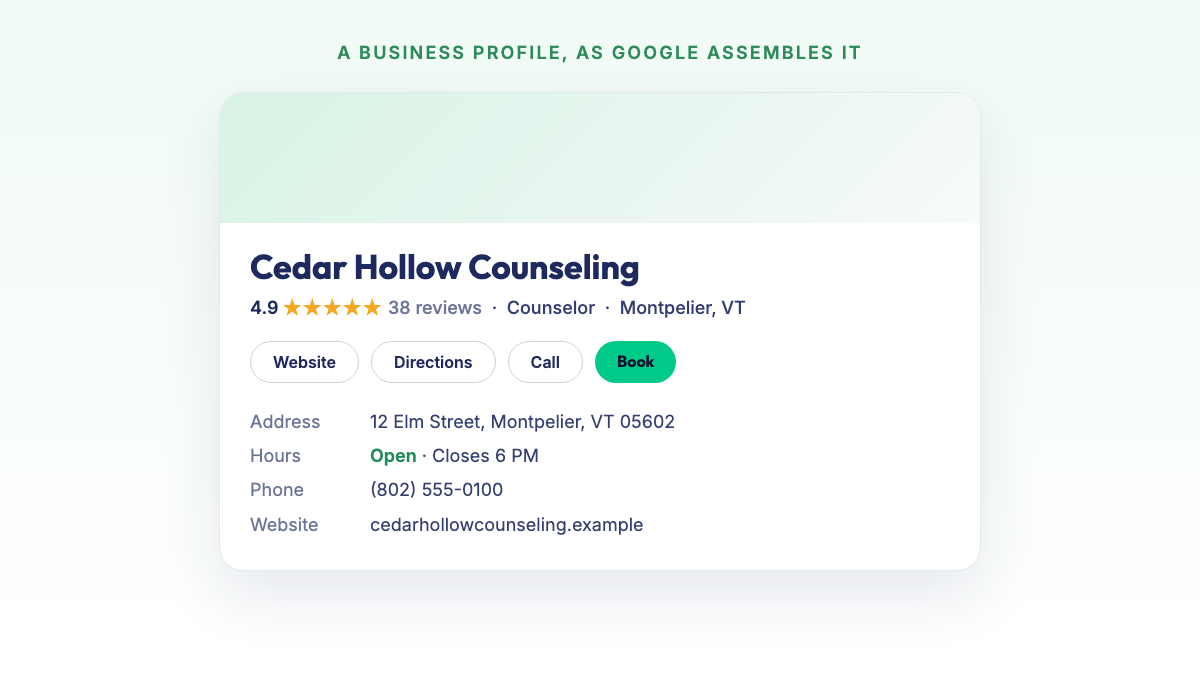
An analysis published September 8 by Search Engine Land, based on a recovered binary exposing part of Geostore, the system Google uses to represent business locations, describes how listings actually get built. A business's name might come from one data source, its phone number from another, its category from a third. Editing your Google Business Profile does not guarantee Google's canonical record updates. Your edit becomes one more piece of evidence entering a system that may already trust conflicting information more.
This is the mechanism behind every mismatch our listing check finds. If Yelp, the NPI registry and an old directory all list a previous phone number, your own correction in Google Business Profile gets outvoted. Fix the outside sources, and the profile follows.
Do this now:
- Run the free listing check to see which outside sources disagree with your Google profile.
- Correct your phone number and address on every directory that is out of date, not just Google.
- Recheck your Google Business Profile a few weeks after fixing outside sources to confirm it updated.
ChatGPT now reads hospital records, and 300 million people ask it health questions weekly
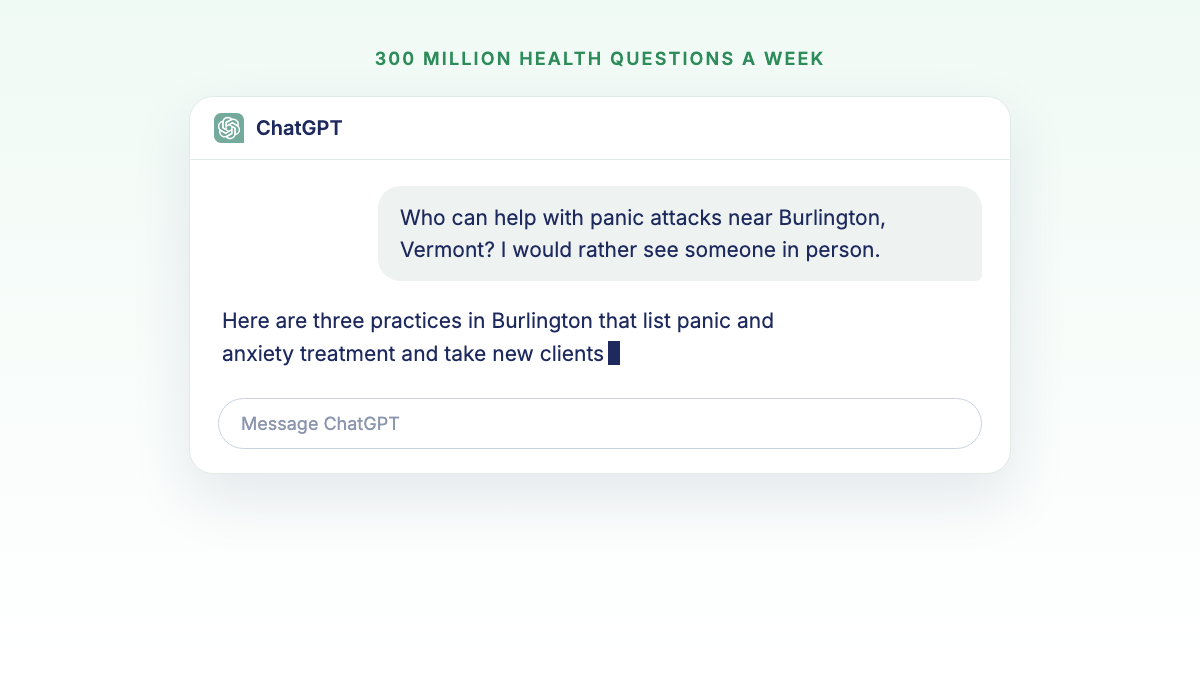
On September 1, OpenAI connected ChatGPT for Healthcare to the Epic electronic health record system. Clinicians at pilot systems including UCSF Health, Cedars-Sinai and Stanford Medicine Children's can now bring a patient's appointment notes, lab results and medications into a read-only ChatGPT conversation. OpenAI said people ask it 300 million health-related questions every week, and that organizations with a signed business associate agreement can use its tools for compliant workflows.
Two things matter here. The people asking ChatGPT those 300 million questions a week are the same people who later ask it who to see, and it can only recommend a practice it can read accurately. The assistant is now built into health systems clients already use, but nothing changes about client data: without a signed BAA, ChatGPT is still not a place for it.
Do this now:
- Confirm no client information is ever entered into ChatGPT without a signed business associate agreement.
- Check that your practice's public information is accurate enough for an AI assistant to summarize correctly.
- Review your listing check report to close any gaps AI tools might read as inconsistent.
Quick wins for the week
- Search your own practice name on Yelp and Facebook to check nobody set up a listing under your name without your knowledge.
- Confirm the phone number on your NPI registry entry matches your current office line.
- Update iOS to version 27 today if you use an iPhone for practice scheduling or communication.
- Ask one current client if they used AI to search for a therapist, and note what they typed.
Final thoughts
This week's stories share one thread: the systems that decide whether a client finds you, whether that client trusts what they find, and whether your data stays safe are all changing faster than any single practice owner can track alone. A researcher's public warning about AI risk, a new Siri built on Gemini, a hospital record system feeding ChatGPT, and the quiet mechanics of how Google actually builds a listing all landed within the same two weeks. None of it requires you to become an AI safety expert. It does require your basic information to be accurate everywhere someone might look, human or machine.
That is the part within your control, and it is also the part most practices have never checked. While you're providing therapy, we're monitoring policy changes, protecting your Google presence, and optimizing for AI search. You shouldn't need to become an SEO expert, compliance specialist, and tech strategist on top of being a therapist.
Get the next edition in your inbox
One email a week on Google, AI search, and running a visible therapy practice. No fluff, unsubscribe anytime.