78% of therapy practice websites are invisible to AI. We checked all 50 states.
The AI Invisibility Index: what 984 practice websites revealed
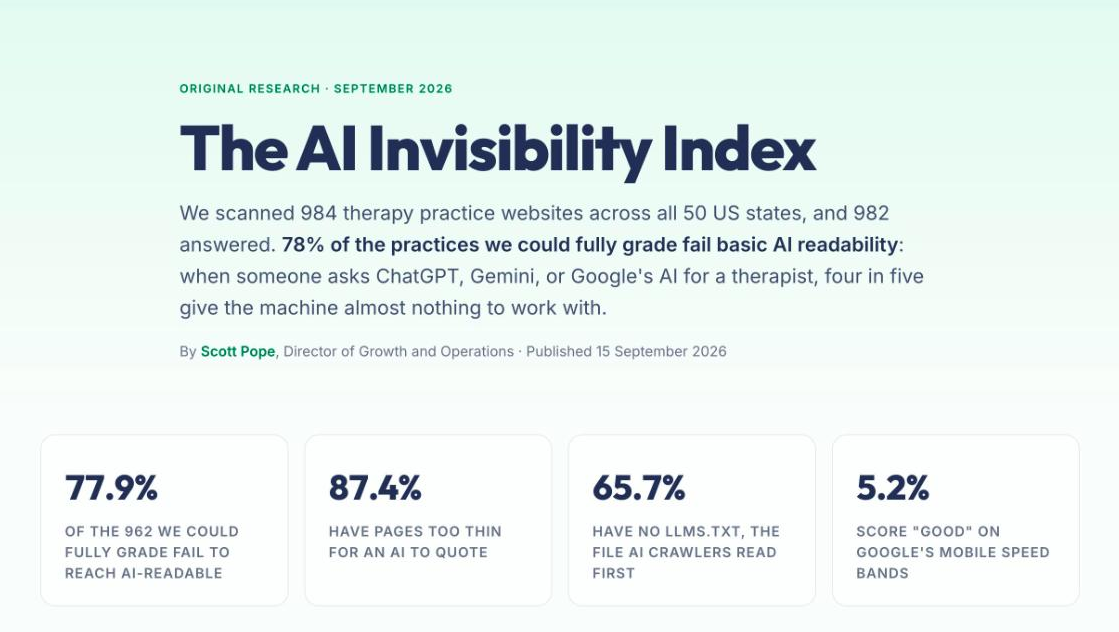
45% of Americans now use AI tools to find local services, and the nervous first questions people ask before finding a therapist increasingly go to ChatGPT and Google's AI. So we measured the other side of that conversation: we scanned 984 independent therapy practice websites across all 50 states, 982 of which answered, with the same engine behind our free scan.
78% of the practices we could fully grade fail basic AI readability. Not because the sites are broken, but because what an AI can read from them is too thin to quote. 87% have pages that list services without describing them. Two thirds are missing llms.txt, the file AI crawlers check first. Only 5% load fast enough to hit Google's "good" band on a phone. And no state passes: the best, Colorado, still fails more than half its practices, while Alabama and Kansas fail 19 in 20.
The encouraging part is the same finding in reverse. The fixes are ordinary website work, and with four in five practices invisible, doing that work is unusually decisive right now.
Do this now:
- Read the full study and find your state in the ranked table at moonraker.ai/ai-invisibility-index
- Run the same checks on your own site in about a minute at moonraker.ai/ai-readiness-scan
- If your site is in the 78%, the study's 'If you run a practice' section is the place to start
Final thoughts
We normally save everything for the weekly edition, and this is the exception that proves the rule. The full dataset is public and free to use. If a colleague would want their state's numbers, forward this along.
Get the next edition in your inbox
One email a week on Google, AI search, and running a visible therapy practice. No fluff, unsubscribe anytime.