AI can name your practice without linking to your website
Our original data, new HIPAA privacy changes, Google Maps appointments and what to check in your search reporting.
AI can name your practice without citing your website
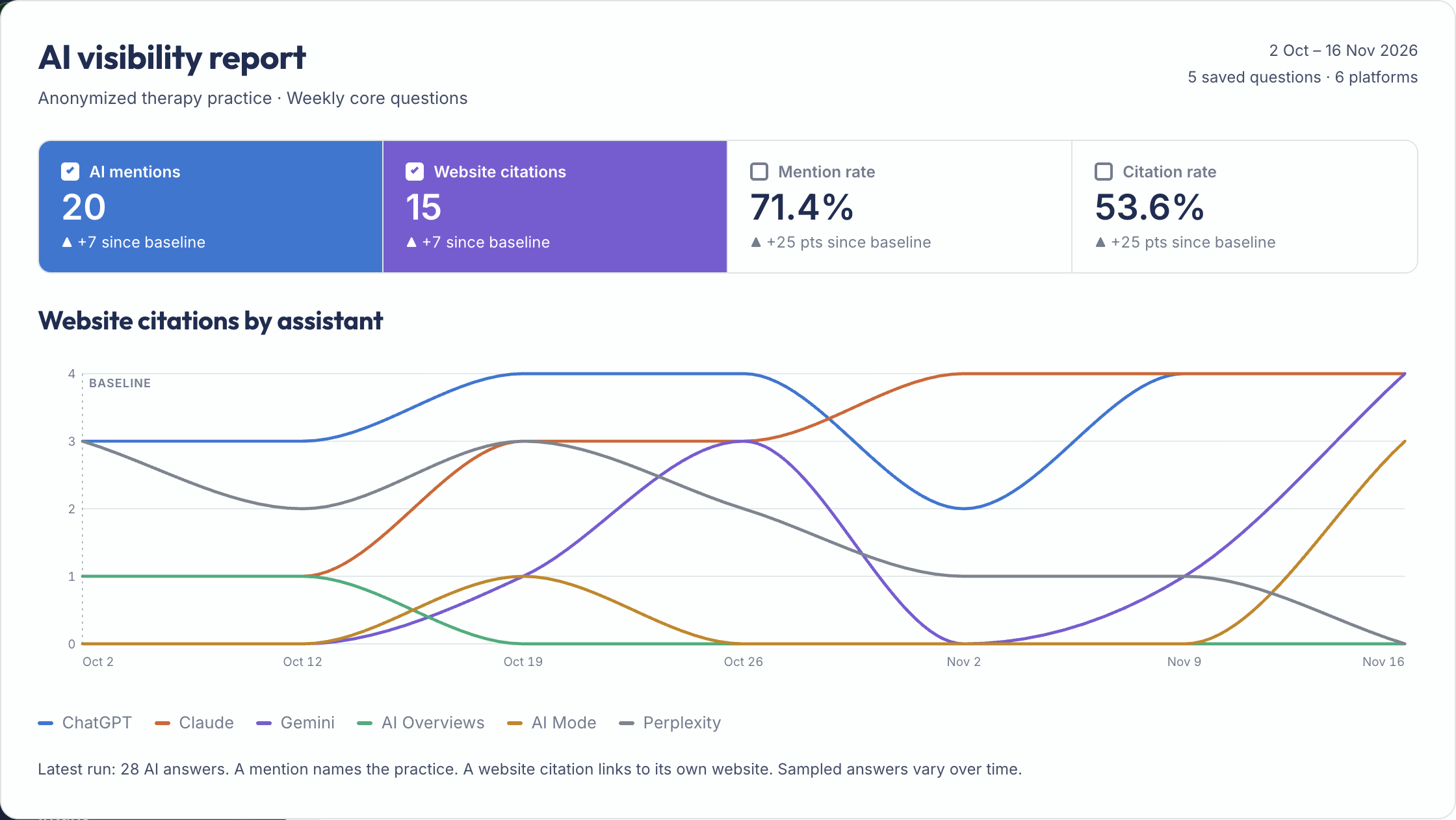
We followed one anonymized therapy practice through seven saved checks between 2 October and 16 November. The same five discovery questions went to six AI platforms each time. In the first run, 13 of 28 captured answers named the practice and eight cited its website. In the latest, those counts were 20 and 15.
The assistant breakdown matters. Perplexity named the practice in four of five answers but cited its own website in none. The saved history also includes citation declines, not just the latest increase.
Our original data article shows how we track mentions, own-site citations, individual pages and source changes, while keeping sampled answers separate from visits and crawler requests. Read the full case and method.
Do this now:
- Ask which exact discovery questions are being checked for your practice.
- Separate answers that name you from answers that cite your own website.
- Review changes over several saved checks before choosing what to work on.
U.S.: new HIPAA Privacy Rule changes affect records requests and website notices

On 16 November, HHS announced a final HIPAA Privacy Rule covering access to health information, care coordination and administrative requirements. For U.S. practices subject to HIPAA, the changes include a shorter standard response window for records requests, revised Notice of Privacy Practices content and website publication of estimated records-copying fees.
The standard access deadline moves from 30 to 15 calendar days, with one extension of up to 30 days. This is the Privacy Rule, separate from the Security Rule proposal covered previously.
HHS says the rule becomes effective 60 days after publication, with general compliance required 180 days after that effective date. The announcement date is not the compliance deadline. Use the transition period to review your records-request process and public information with whoever manages privacy compliance.
Do this now:
- Confirm whether the rule applies to your practice and record its published implementation dates.
- Review who receives records requests and how response deadlines are tracked.
- Have your privacy lead review the notice and website fee information that will need updating.
Therapists: make your Google Maps profile easy to act on
For a therapy practice, a Google Maps visit should lead to accurate contact details and a working appointment link. On 16 November, Google expanded Ask Maps with appointment-finding features, showing how Maps is moving beyond finding a business toward helping people contact one.
The announced appointment categories do not include therapy. For therapists, the immediate task is to check the profile people already use: does the booking link open the correct intake or consultation page, and do the phone number, location and hours agree with your website?
If your practice offers in-person and online care, make that distinction clear in your public information. Test the journey on a phone, where someone may be deciding whether your practice fits before they ever reach your website.
Do this now:
- Test your Maps appointment link on a phone and confirm it opens the correct consultation or intake page.
- Check that your profile and website agree on location, phone number and hours.
- Describe your in-person and online services clearly without claiming unannounced therapy booking features.
Search reports can now separate name searches from discovery searches more easily
On 16 November, Google added branded-query classification, visual-search reporting and combined country/device filters to its Search Analytics API. These extend reporting options that were already arriving in Search Console into automated dashboards.
For a therapy practice, the useful question is whether visitors already knew your name or found you while looking for a service. Separating those groups can make a search report easier to interpret. The branded classification is limited to eligible properties, so an absent result is not proof that nobody searched for your practice.
This update changes access to reporting data. It is not a ranking boost, and it does not mean an existing dashboard has adopted the new filters. Ask your reporting provider which breakdowns are available for your website before changing how you judge progress.
Do this now:
- Ask whether your search report separates practice-name searches from service discovery.
- Compare like-for-like periods and keep mobile and country differences visible.
- Treat unavailable classification as missing data rather than zero demand.
A website can load for people while its security settings block Google
Google published new guidance on 11 November about moving websites behind a content delivery network, the service that helps deliver pages quickly. During a move, an initially empty cache can still pass requests back to the main server, even when the new network looks fast.
A second risk matters to practice owners: broad bot-protection settings can put a CAPTCHA or error page in front of Googlebot. Google says its crawlers cannot complete those challenges. Left in place, those restrictions can affect whether pages remain available in Search.
If you have changed hosting, added a firewall or switched security settings, ask your website provider to verify crawler access as well as normal browsing. The answer is targeted security with verified-crawler handling, rather than turning off protection across the site.
Do this now:
- Tell your provider about any recent hosting, firewall or bot-protection change.
- Ask for a live crawler-access check on your homepage and key service pages.
- Keep security enabled while your provider fixes rules that challenge verified Google crawlers.
Final thoughts
This week's updates all point to the value of checking what is actually happening. An AI mention may not link to your website. A new Maps feature may not cover therapy bookings. A security setting can work for visitors while blocking a search crawler. Start with the part that affects your practice, ask for the evidence and make one clear change. For U.S. practices subject to HIPAA, put the new Privacy Rule review on the calendar during its implementation period.
Get the next edition in your inbox
One email a week on Google, AI search, and running a visible therapy practice. No fluff, unsubscribe anytime.